On Wednesday I went to Columbus and testified about House Bill 483 before the Ohio House Finance and Appropriations Committee.
Here's my prepared testimony.
Olivera Perkins quoted some of it in her Tuesday PD article about the bill.
Update 4/7: News this morning -- the Committee is removing the language that would require online filing of unemployment claims from the version of HB 483 they'll be reporting out. Progress!
(Of course there's plenty of opportunity for the House, or the Senate, to put some version of it back in before HB 483's final passage.)
4.06.2014
3.20.2014
HB 483: Unemployment compensation only for the connected?
Hidden deep in Ohio House Bill 483, one of the eleven bills spawned by Governor Kasich's "Mid-Biennium Review", is a one-sentence change in the Unemployment Compensation process that will create yet another obstacle for any newly unemployed Ohioan who's among the state's two and a half million adults still lacking home broadband access or the skills to use it.
Here's the sentence (in RC 4141.28 -- my emphasis):
Think this isn't such a big deal outside of a few digitally challenged neighborhoods in Cleveland, Columbus, Akron, Toledo, Youngstown, Dayton and Concinnati? Think again:
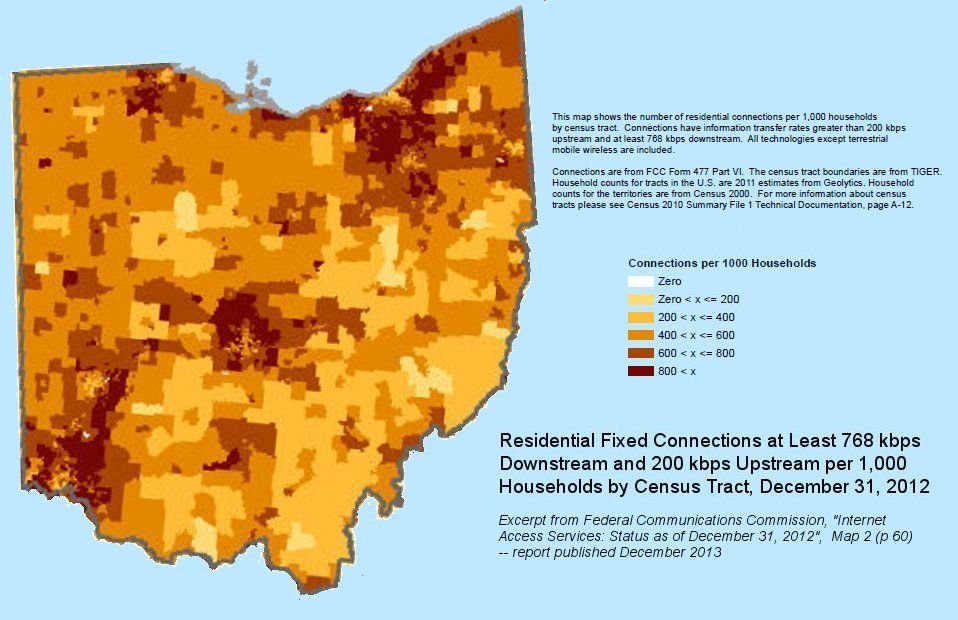
Yes, you got that right. At the end of 2012, according to the FCC's most recent information, most of the state had home broadband connections in fewer than 60% of households. The percentage in most of southeast and central Appalachian Ohio was less than 40%.
(Check out Connect Ohio's 2012 Residential Technology Assessment to learn more.)
The State of Ohio, like many public and private institutions, is understandably impatient to migrate as much of its public business to the Internet as possible, and eliminate the expense of its legacy systems (like offices and phone centers) as soon as possible. And for many of the state's "customers" this migration can't happen fast enough. Who wants to return to standing on the unemployment line?
But that understandable impatience seems to be leading the Ohio Department of Jobs and Family Services, like many Internet-eager institutions, to ignore a fundamental rule of IT systems management: Never deploy a mission-critical software or hardware system without training and equipping all the people who will have to use it.
In the case of shifting critical ODJFS social and income support functions to Internet-only form, this means coming to grips with the uncomfortable fact that many thousands of the agency's current and future clients just don't have the basic skills, equipment or fast Net access to follow them there. "Coming to grips" meaning: Either start taking some serious steps to help those clients acquire the necessary skills, equipment and access (= spend money!), or keep providing human/phone alternatives (also = spend money!)
Of course ODJFS could just throw all those digitally unprepared unemployed Ohioans out of the boat and let them somehow learn to swim on their own, or sink.
But that inevitably means letting thousands fail to receive the unemployment insurance benefits to which they're legally entitled. And no one in the Kasich Administration or the General Assembly would want that to happen.
Would they?
Here's the sentence (in RC 4141.28 -- my emphasis):
Effective July 1, 2015, an individual shall file an application for determination of benefit rights and a claim for benefits by electronic means in a manner prescribed by the director, except that no individual shall be required to file such an application or claim by electronic means if one or more of the following circumstances apply:So if you think you might get laid off after mid-2015, make sure you have a computer and a DSL line or cable modem before the axe falls. And you might want to pay that Internet bill a few months ahead, while you still have a little discretionary income... because your $300-to-400-a week unemployment check will have to cover food, rent, heat, electricity and the cellphone you use to look for work.
(1) The individual is legally prohibited from using a computer;
(2) The individual has a physical or visual impairment that makes the individual unable to use a computer;
(3) The individual has limited ability to read or write effectively in a language in which the electronic application or claim is available;
(4) A disaster or emergency declared by the governor prevents compliance with the electronic filing requirement.
Think this isn't such a big deal outside of a few digitally challenged neighborhoods in Cleveland, Columbus, Akron, Toledo, Youngstown, Dayton and Concinnati? Think again:
Yes, you got that right. At the end of 2012, according to the FCC's most recent information, most of the state had home broadband connections in fewer than 60% of households. The percentage in most of southeast and central Appalachian Ohio was less than 40%.
(Check out Connect Ohio's 2012 Residential Technology Assessment to learn more.)
The State of Ohio, like many public and private institutions, is understandably impatient to migrate as much of its public business to the Internet as possible, and eliminate the expense of its legacy systems (like offices and phone centers) as soon as possible. And for many of the state's "customers" this migration can't happen fast enough. Who wants to return to standing on the unemployment line?
But that understandable impatience seems to be leading the Ohio Department of Jobs and Family Services, like many Internet-eager institutions, to ignore a fundamental rule of IT systems management: Never deploy a mission-critical software or hardware system without training and equipping all the people who will have to use it.
In the case of shifting critical ODJFS social and income support functions to Internet-only form, this means coming to grips with the uncomfortable fact that many thousands of the agency's current and future clients just don't have the basic skills, equipment or fast Net access to follow them there. "Coming to grips" meaning: Either start taking some serious steps to help those clients acquire the necessary skills, equipment and access (= spend money!), or keep providing human/phone alternatives (also = spend money!)
Of course ODJFS could just throw all those digitally unprepared unemployed Ohioans out of the boat and let them somehow learn to swim on their own, or sink.
But that inevitably means letting thousands fail to receive the unemployment insurance benefits to which they're legally entitled. And no one in the Kasich Administration or the General Assembly would want that to happen.
Would they?
3.07.2014
What the digital divide looks like in Cleveland
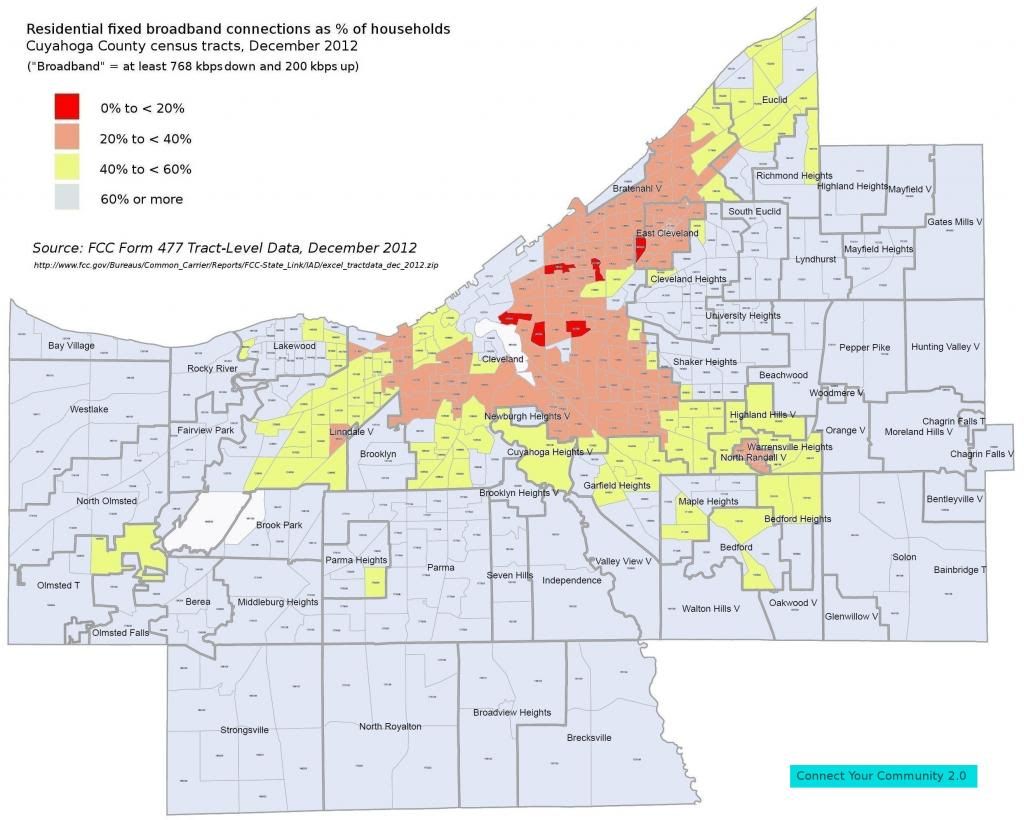
Thanks to this Atlantic Cities article, I recently learned that the FCC now publishes Census tract-level data on the ratio of "residential fixed broadband connections" (cable modem and DSL accounts) to households. The December 2012 data were posted on the FCC site in December 2013.
So here's what the digital divide looks like in Cuyahoga County.

And here's the city of Cleveland:

Looks a lot like this, doesn't it?
(See the CYC Project's Cuyahoga County Internet Survey for more information about who's connected and who's not.)
So here's what the digital divide looks like in Cuyahoga County.
And here's the city of Cleveland:
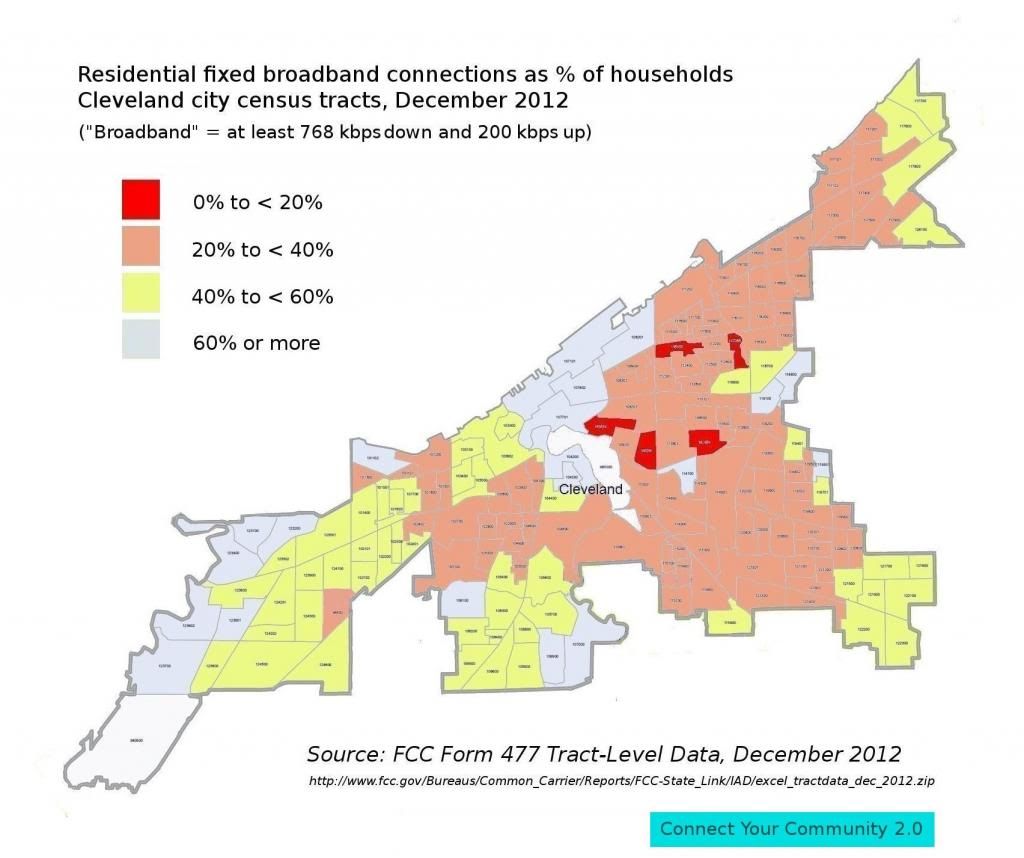
Looks a lot like this, doesn't it?
(See the CYC Project's Cuyahoga County Internet Survey for more information about who's connected and who's not.)
1.20.2014
On MLK Day: Which Clevelanders' jobs are worth least?
No surprises, but it's Martin Luther King Day so let's put it out there. From the same source as the last few posts, the U.S. Census' most recent American Community Survey (2010-2012 Three Year Estimate):
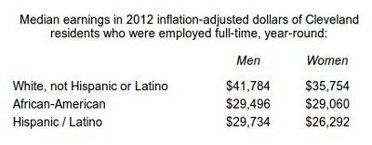 Note well: The median pay of a fully employed African-American or Hispanic Cleveland resident qualifies him or her -- if he or she is the only earner in a family of four or more -- for Federal food assistance and Medicaid.
It's easy to forget (especially when we're so seldom reminded) that King's last days were spent in Memphis supporting a strike by low-income African-American sanitation workers demanding union recognition:
It's easy to forget (especially when we're so seldom reminded) that King's last days were spent in Memphis supporting a strike by low-income African-American sanitation workers demanding union recognition:
... [T]he sanitation men had been asking the city for recognition of their union and for a resolution of their many grievances since 1963. These workers lived below the poverty level while working fulltime jobs, and 40 percent of them qualified for welfare to supplement their meager salaries. [My emphasis]Not unlike some of our neighbors in 2014.
1.15.2014
Success stories
So, here's the point of the previous three posts:
The Clevelanders whose minimal average paychecks are discussed in these posts are not "the poor", as this term is generally used. They aren't unemployed, or stuck in part-time or seasonal work. They aren't "on welfare". They're not living on disability checks. For the most part, they're not homeless.
Cleveland has plenty of residents in each of these situations (except for "on welfare", which doesn't really exist any more). But that's not who we're talking about here.
No, we're talking here about the city's success stories. We're talking about the people who got the job -- those who went to work and collected a paycheck for at least 35 hours, for at least 50 weeks out of 52.
According to the Census, only about half of the city's adults who are "in the labor force" during any given year manage to be "full-time, year-round employed". In 2012, according to the Census, about 94,000 Clevelanders achieved this elite status.
And half of them earned less than $32,000 (pre-tax) for that year of work.
The Clevelanders whose minimal average paychecks are discussed in these posts are not "the poor", as this term is generally used. They aren't unemployed, or stuck in part-time or seasonal work. They aren't "on welfare". They're not living on disability checks. For the most part, they're not homeless.
Cleveland has plenty of residents in each of these situations (except for "on welfare", which doesn't really exist any more). But that's not who we're talking about here.
No, we're talking here about the city's success stories. We're talking about the people who got the job -- those who went to work and collected a paycheck for at least 35 hours, for at least 50 weeks out of 52.
According to the Census, only about half of the city's adults who are "in the labor force" during any given year manage to be "full-time, year-round employed". In 2012, according to the Census, about 94,000 Clevelanders achieved this elite status.
And half of them earned less than $32,000 (pre-tax) for that year of work.
1.13.2014
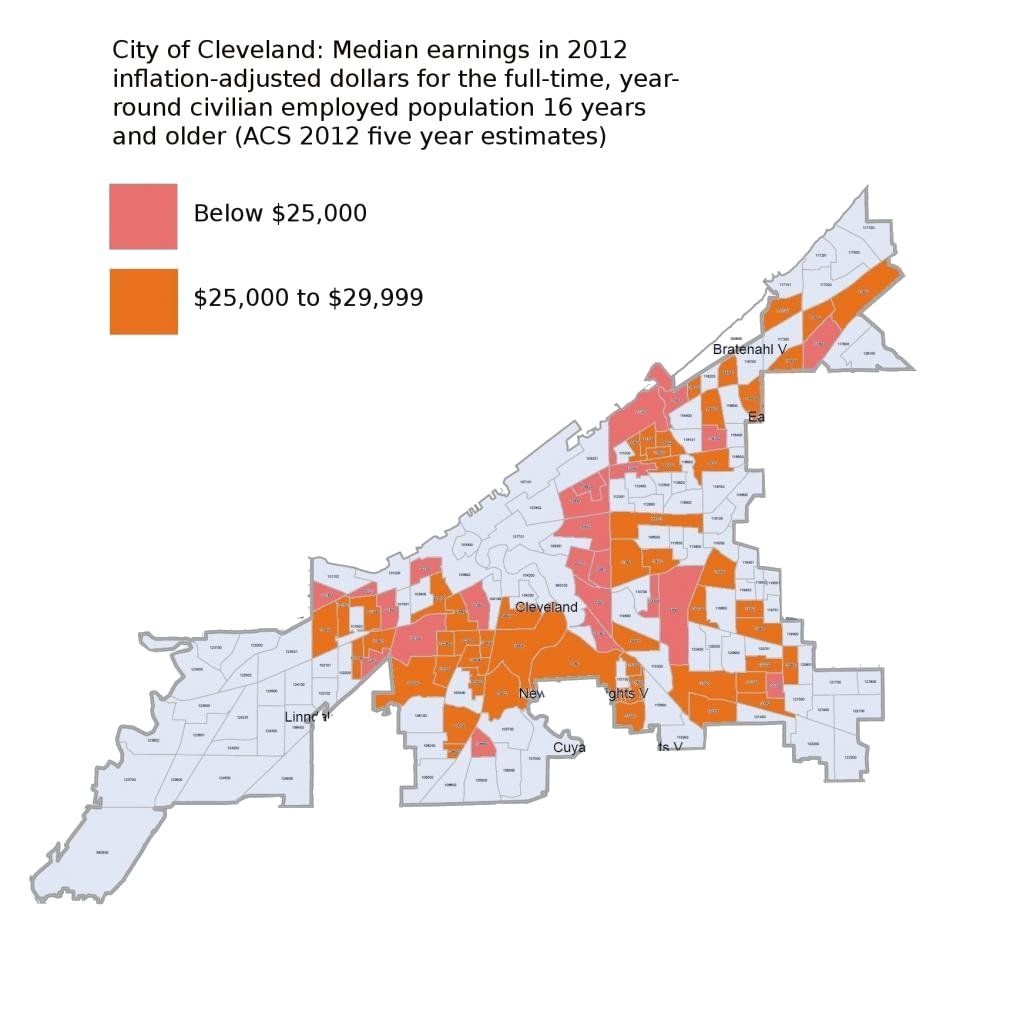
"The best anti-poverty program is a job..."
... sometimes. Sometimes, not so much.
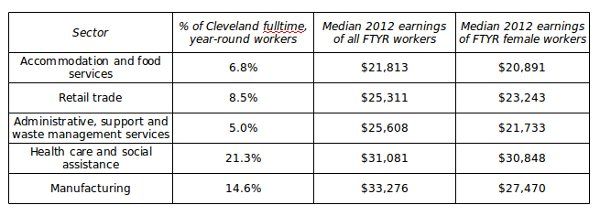
From the same American Community Survey data cited in the last post, here are the median 2012 earnings of Clevelanders who worked full-time, year-round in five sectors that, taken together, accounted for about 55% of our city's 94,000 fully-employed residents:
The 2012 Federal “poverty level” for a three-person household was $19,090, and for a four-person household was $23,050.
The eligibility ceiling for SNAP (food assistance) benefits was 130% of these poverty guidelines: $24,817 for a family of three, $29,965 for a family of four.
The ceiling for Medicaid was 133% of the poverty guidelines: $25,390 for a family of three, $30,657 for a family of four.
Compare these "poverty program" thresholds to the median pay levels for full-time workers listed above -- remembering that "median" means half earned less.
The bottom line: A single parent with two or three kids and a full-time job, living in Cleveland, has a pretty good chance of qualifying for Federal food assistance and Medicaid... especially if her job is in food services, retail or “administrative, support and waste management”.
From the same American Community Survey data cited in the last post, here are the median 2012 earnings of Clevelanders who worked full-time, year-round in five sectors that, taken together, accounted for about 55% of our city's 94,000 fully-employed residents:
The 2012 Federal “poverty level” for a three-person household was $19,090, and for a four-person household was $23,050.
The eligibility ceiling for SNAP (food assistance) benefits was 130% of these poverty guidelines: $24,817 for a family of three, $29,965 for a family of four.
The ceiling for Medicaid was 133% of the poverty guidelines: $25,390 for a family of three, $30,657 for a family of four.
Compare these "poverty program" thresholds to the median pay levels for full-time workers listed above -- remembering that "median" means half earned less.
The bottom line: A single parent with two or three kids and a full-time job, living in Cleveland, has a pretty good chance of qualifying for Federal food assistance and Medicaid... especially if her job is in food services, retail or “administrative, support and waste management”.
What a job is worth in Cleveland
According to the U.S. Census' most recent American Community Survey:
The median annual pay earned by the 94,000 (or so) Cleveland residents who worked full-time, year-round in 2012 was $32,716.
Divided by 2,080 hours of work, that's $15.73 an hour.
"Median" means that half of the city's 94,000 (or so) fully employed workers earned less. (For comparison, the 2012 median for the whole state of Ohio was $41,759.)
Adjusted for inflation, Cleveland's 2012 full-time year-round earnings median was down 12% from the level found by the Census in 1999 – about $2.16 an hour less.
51% of Cleveland's full-time year-round workers are women. Their median pay earned in 2012 was $30,959. Divided by 2,080 hours of work, that's $14.88 an hour. (Again, this means half of those fulltime female workers made less.)
Source: 2010-2012 American Community Survey 3-Year Estimates, S2404: Industry by sex and median earnings in the past 12 months (in 2012 inflation-adjusted dollars) for the full-time, year-round civilian employed population 16 years and over
The median annual pay earned by the 94,000 (or so) Cleveland residents who worked full-time, year-round in 2012 was $32,716.
Divided by 2,080 hours of work, that's $15.73 an hour.
"Median" means that half of the city's 94,000 (or so) fully employed workers earned less. (For comparison, the 2012 median for the whole state of Ohio was $41,759.)
Adjusted for inflation, Cleveland's 2012 full-time year-round earnings median was down 12% from the level found by the Census in 1999 – about $2.16 an hour less.
51% of Cleveland's full-time year-round workers are women. Their median pay earned in 2012 was $30,959. Divided by 2,080 hours of work, that's $14.88 an hour. (Again, this means half of those fulltime female workers made less.)
Source: 2010-2012 American Community Survey 3-Year Estimates, S2404: Industry by sex and median earnings in the past 12 months (in 2012 inflation-adjusted dollars) for the full-time, year-round civilian employed population 16 years and over
Still lazy after all these years
So I'm, um, starting to write here again.
This weblog was started way back in 2003. In July 2006, I switched to a WordPress site (CallahansClevelandDiary.com), which lasted until early 2013, when, for reasons too complicated and boring to explain here, I lost access to the hosting site along with all the files.
But the truth is, Callahan's Cleveland Diary really ran out of steam a year before that. Part of the reason was time; I was lucky enough to get to run a big community technology project funded by Federal broadband stimulus funds (which is my real work) and I just didn't have the bandwidth for blogging. Part of the reason was boredom: I'd spent years writing about the same handful of topics for a shrinking audience (it was never very big in the first place), and it was all getting pretty repetitious.
Well, now the big project is over, a couple of years have passed, and that old itch seems to have returned. So here I am back at the old stand, with some new (or maybe just reconditioned) thoughts to share about "economics, politics and real life in Cleveland".
As for that six years of lost blogging at CallahansClevelandDiary.com, I've managed to salvage a lot of those posts via the still-awesome Internet Archive, and I'm slowly but steadily re-posting them to a new "sibling blog" of this one called Cleveland Diary: The Lost Years.
So, there you have it. Cleveland Diary is back. Thanks for stopping by.
This weblog was started way back in 2003. In July 2006, I switched to a WordPress site (CallahansClevelandDiary.com), which lasted until early 2013, when, for reasons too complicated and boring to explain here, I lost access to the hosting site along with all the files.
But the truth is, Callahan's Cleveland Diary really ran out of steam a year before that. Part of the reason was time; I was lucky enough to get to run a big community technology project funded by Federal broadband stimulus funds (which is my real work) and I just didn't have the bandwidth for blogging. Part of the reason was boredom: I'd spent years writing about the same handful of topics for a shrinking audience (it was never very big in the first place), and it was all getting pretty repetitious.
Well, now the big project is over, a couple of years have passed, and that old itch seems to have returned. So here I am back at the old stand, with some new (or maybe just reconditioned) thoughts to share about "economics, politics and real life in Cleveland".
As for that six years of lost blogging at CallahansClevelandDiary.com, I've managed to salvage a lot of those posts via the still-awesome Internet Archive, and I'm slowly but steadily re-posting them to a new "sibling blog" of this one called Cleveland Diary: The Lost Years.
So, there you have it. Cleveland Diary is back. Thanks for stopping by.
7.09.2006
Cleveland Diary has moved!

Cleveland Diary started here three years ago. (I was Blogger before Blogger was Google... isn't that a song or something?) But the time has come to move along.
This site will stay up for the foreseeable future, and I'm linking back to its archives from the new site. But all posting from here on out will be at
www.callahansclevelanddiary.com.If you have Cleveland Diary on your blogroll or an RSS feed, please update the link.
Thanks.
6.29.2006
Time Warner takeover: It's not just Cleveland (a regionalism opportunity)
In response to Jill's comment on my last post, it's important to note that it won't only be Cleveland City Council trying to deal with Time Warner this Summer. As a result of the Adelphia buyout deal and some territory-trading with Comcast, Time-Warner intends to take over franchises in thirty-seven municipalities in Cuyahoga County alone (and over five hundred statewide). Jill's home town, Pepper Pike, is one of them. Click on the map to get the picture:
If you live in one of these communities, you should be talking to your own city or village council first. Of course, one suggestion you could make is that this might be an excellent time to try a little of that "regional cooperation" we keep hearing about. There may not be time to organize all thirty-seven communities to deal with Time-Warner together, especially if the Federal government imposes new time limits on franchise approvals -- but then again, you never know unless you try. And it can't hurt for the cities to at least explore some coordination and information sharing.
"We must all hang together, or assuredly we shall all hang separately."
Time Warner takeover of Adelphia Cable about to clear final hurdle; Cleveland, here they come
Harold has the story at Public Knowledge today. He's hoping the FCC might require Time Warner to practice net neutrality. Don't hold your breath.
In case you haven't been paying attention, Cleveland and many other NEO communities are part of Time Warner's piece of this deal. Cleveland City Council's Public Utilities Committee (chaired by Ward 17's Matt Zone) should soon be getting Time Warner's formal application for City approval of the takeover and renewal of the local franchise, which expires in September.
How much authority the City will ultimately have in this matter is up to Congress, but under current law there's a lot to talk about, so Council's franchise hearings could be a big deal. Some of the issues: cable rates and programming, the future of public access (Time Warner has started to charge a $25 fee for citizens to run a program on Akron's public channel), future support for the Neighborhood Technology Fund and other community benefits. Also expect the Communications Workers to make a stink about Time Warner's anti-unionism.
Presumably Time Warner's goal will be to shuck off as much of this civic-obligation stuff as possible, and get on with locking down all corners of the local pay-TV market before AT&T makes its move with LightSpeed. Expect to hear a great deal of blather about how competitive the cable market is about to become, and how unfair it is to ask Time Warner to do anything in exchange for the use of city streets and poles, other than make as much money as possible.
6.28.2006
Senate Commerce Committee passes telecom bill, NN amendment not included
Well, the Senate Commerce Committee just finished its three-day markup of S. 2686, the "Communications, Consumers’ Choice, and Broadband Deployment Act" (aka "COPE Act Lite") and approved it 15-7. Committee Chairman Ted Stevens said just yesterday that he didn't think the bill would make it to the Senate floor unless he could find 60 votes for it. Does this mean he found them? Which side is he counting Mike Dewine on?
Harold Feld posted a great summary of the bill's good and bad points at wetmachine Monday. After two days in the sausage machine, the final bill apparently hasn't changed much. The biggest (and closest) vote happened around 4 this afternoon, when the Snowe/Dorgan Net Neutrality amendment failed 11-11 (a tie means it loses). All Democrats voted yes, all Republicans except Snowe herself voted no. A John Kerry amendment strengthening the bill's anti-redlining language also failed.
As Harold points out, the bill is mildly better for cities than the House's COPE Act. It leaves cities in charge of cable and IPTV franchising but imposes a 90-day time limit to approve franchise applications, requires use of a standard application designed by the FCC, and otherwise severely limits the city's negotiating options. It also clearly allows selective buildouts (cherrypicking, redlining) within a community, just like COPE. And it removes cities from the list of agencies that have to approve the mid-franchise transfer of a cable company to new owners.
The bright spot in the bill is the municipal networking section, which, like COPE, prevents state legislatures from shutting down city broadband projects. (This provision handily survived an attempt by Democrat Jay Rockefeller of West Virginia to gut it.) While the Senate version adds a couple of hoops for muni broadband projects to jump through, the end result is a solid win for the Community Right To Network. Nice, but not nice enough to outweigh all the other crud.
So... 60 out of 99 votes needed, and a bright line drawn on Net Neutrality. If the GOP leadership wants this thing to pass, they probably can't let Senator Mike vote the other way this time -- which means Net Neutrality might become a real issue in the Senate race after all.
Then we can enjoy the spectacle of Dewine explaining why he went to bat for a telecom giant that wants to sell off its 800,000 Ohio households because they don't fit into its hot new ultrafast fiber video/Internet plans.
P.S. Do you think Sherrod will ever add "big telecom" to the list of pay-to-play industries Congress should be independent of?
6.27.2006
AT&T DSL overcharge update: Customer service says sorry, no refund
So I called AT&T customer service first thing yesterday to explain how they've been overcharging me for eight months and ask for my money back.
I could bore you with the details of the conversation, but here's the bottom line: No.
AT&T's position, according to the supervisor of my very nice service representative Nancy, is that I should have called them last November if I wanted my bill lowered to their new, lower rate. The fact that they didn't tell me (or you, or anyone) that the rate for month-to-month DSL Express service had been lowered, and still aren't telling us (unless we burrow deep into the "terms of service" fine print in their ads), and kept sending me bills that said I owed them the old rate, is immaterial. It was up to me to figure it out and tell them that the bills were too high. Since I paid those bills, too bad, but they're keeping the money.
Of course they'd be delighted to offer me a much better rate on my next year of service...
I called the Office of Consumers' Counsel but, as I suspected, neither OCC nor the PUCO is allowed by law to deal with consumer complaints about DSL, because it's an unregulated service. The OCC staffer suggested contacting the Federal Communications Commission.*
So, this is interesting. AT&T has, like, $160 that they overbilled me. They're not giving it back. There have to be lots of other customers (millions?) who are "similarly situated". If you've had an SBC/AT&T DSL account for a couple of years, you may well be one of us.
Do the words "class action" ring any bells?
*Update: From the FCC website...
How do I file a complaint against my Internet Service Provider?
The FCC does not regulate the Internet or Internet Service Providers (ISPs). You may contact your state consumer protection office...
6.25.2006
AT&T is overcharging me for DSL... how about you?
I just figured out that AT&T (formerly SBC) has been overcharging my family $20 a month for our home DSL service.
The company's current advertised price for "High Speed Internet Express" service is $29.99 a month, once you're past your initial one-year contract at the $12.99-$14.99 promotional rate. "Express" service means ADSL with up to 1.5 Mbps download and up to 384 Kbps upload, with one dynamic IP address. That's what we've got.
But AT&T is still billing us $49.95 a month for it.
And I'm willing to bet we have lots of company.
Here's the history: We signed up for a year of "Standard" DSL in April 2003. At the time, that meant paying $49.95 for 768 Kbps down and 128 up. That contract ran out in April 2004, and we continued with month-to-month service at the same price.
At some point -- about the same time as the contract ended, I think -- we noticed that our download speed had doubled and was now routinely testing at 1.2 Mbps or better. Hey, we thought, that's pretty cool. In retrospect, I guess that was SBC converting our "Standard" service to their new "Express" category, at the same $49.95 price. No complaints here.
But then last October SBC cut their "ongoing rate" for DSL Express accounts from $49.95 to $29.99. Same service, $20 a month cheaper... for people just like us, using "ongoing" month-to-month 1.5 Mbps service.
Only they didn't bother to tell us, or reduce our bills. So every month since last November, SBC/AT&T has billed us -- and we've paid -- twenty bucks that we didn't owe them.
Yes, of course, I'm going to call the company first thing tomorrow morning and demand our $160 back. And I'm pretty confident that I'll get it, though it may take some pushing and shoving.
But here's the thing: What if I hadn't noticed? AT&T has 7.4 million DSL lines in service across the country. At least a million -- maybe a lot more -- must be Standard/Express customers who've had their accounts for two or three years, like my family. How many are still shelling out fifty dollars a month for service that's supposed to cost them thirty? How much extra money has AT&T collected from all us schlubs? $150 million? $200 million?
And how much more will they collect before the word gets around and somebody makes them stop?
Once upon a time, the PUCO and Ohio Consumers Counsel were allowed to check into telephone company rates and billing practices. But now broadband services are deregulated (and soon, under "alternative regulation", basic phone rates will be too). No more PUCO jurisdiction, no more OCC authority. Nobody's watching any more.
We're on our own, folks. Ain't deregulation grand?
6.22.2006
WITH NO CHANCE OF PASSAGE, DEWINE VOTES FOR MINIMUM WAGE HIKE. HEY, WHAT ABOUT OHIO?
Mike Dewine was one of eight Republican Senators to vote "Yes" yesterday on Ted Kennedy's proposal to raise the national minimum wage. With those eight -- four of whom, like Dewine, have re-election races this year -- the bill actually passed 52-48. But it needed a supermajority of 60 votes under the Senate's budget legislation rules, so of course it was dead from the start.
A cynic might see Dewine's vote as a cost-free way to inoculate himself on an issue that may well be center stage in Ohio this November. The Ohio Fair Minimum Wage issue is very likely to get on the ballot, with Sherrod Brown as a loud, proud supporter. Dewine can't stop the issue from raising Democratic turnout, but he's just made it more difficult for Brown to paint him as a villain on the issue.
But let's lower the cynicism setting for a minute. This isn't Dewine's first vote for a minimum wage hike... not exactly. Maybe he really feels in his heart that it's time for minimum-wage workers in Ohio to get a few raises.
If so, there's an easy way for him to prove his sincerity. The Ohio Fair Minimum Wage proposal would create a state requirement starting at $6.85 an hour with annual cost of living bumps. That's virtually identical to the proposal Dewine just voted for (three annual steps to $7.25).
So why doesn't Senator Dewine endorse the petition drive and promise to support the issue when it's on the ballot in November?
Of course, those partisan Democrats behind the petition campaign probably haven't asked for his support. But there's no reason to let them call the shots, right? And unlike the futile vote Dewine cast yesterday in the Senate, his active endorsement of the state issue might really help it to pass -- and would really neutralize the issue in the Senate race.
Seems like a pretty obvious move... assuming, of course, that Dewine really wants the minimum wage to go up.
(To prove my sincerity: If anyone in the Dewine campaign reads this, I promise to attend his Ohio Fair Minimum Wage endorsement press conference, blog the heck out of it, and importune all my fellow "progressive Ohio bloggers" to do the same. Really.)
Mike Dewine was one of eight Republican Senators to vote "Yes" yesterday on Ted Kennedy's proposal to raise the national minimum wage. With those eight -- four of whom, like Dewine, have re-election races this year -- the bill actually passed 52-48. But it needed a supermajority of 60 votes under the Senate's budget legislation rules, so of course it was dead from the start.
A cynic might see Dewine's vote as a cost-free way to inoculate himself on an issue that may well be center stage in Ohio this November. The Ohio Fair Minimum Wage issue is very likely to get on the ballot, with Sherrod Brown as a loud, proud supporter. Dewine can't stop the issue from raising Democratic turnout, but he's just made it more difficult for Brown to paint him as a villain on the issue.
But let's lower the cynicism setting for a minute. This isn't Dewine's first vote for a minimum wage hike... not exactly. Maybe he really feels in his heart that it's time for minimum-wage workers in Ohio to get a few raises.
If so, there's an easy way for him to prove his sincerity. The Ohio Fair Minimum Wage proposal would create a state requirement starting at $6.85 an hour with annual cost of living bumps. That's virtually identical to the proposal Dewine just voted for (three annual steps to $7.25).
So why doesn't Senator Dewine endorse the petition drive and promise to support the issue when it's on the ballot in November?
Of course, those partisan Democrats behind the petition campaign probably haven't asked for his support. But there's no reason to let them call the shots, right? And unlike the futile vote Dewine cast yesterday in the Senate, his active endorsement of the state issue might really help it to pass -- and would really neutralize the issue in the Senate race.
Seems like a pretty obvious move... assuming, of course, that Dewine really wants the minimum wage to go up.
(To prove my sincerity: If anyone in the Dewine campaign reads this, I promise to attend his Ohio Fair Minimum Wage endorsement press conference, blog the heck out of it, and importune all my fellow "progressive Ohio bloggers" to do the same. Really.)
6.21.2006
TWO TELECOM TALES: OR WHY IT MIGHT NOT BE THE GREATEST IDEA TO PUT AT&T AND VERIZON IN CHARGE OF OUR INTERNET ACCESS
1) "AT&T rewrites rules: Your data isn't yours"
From today's San Francisco Chronicle via havecoffeewillwrite :
This doesn't show up in a Google News search, but a friend in the Communications Workers sent me a copy of a May 10 Wall St. Journal article by Dionne Searcey and Dennis Berman that says, in part:
If the WSJ is correct, all these customers are up for sale as "less valuable" because they're "not slated for fiber upgrades", i.e. Verizon has no intention of offering them its new fiber-optic IPTV and Internet service ("FiOS").
Do you think Verizon explained all this to Sherrod Brown (who represents those Lorain/Medina households), Ted Strickland (whose district includes much of the Verizon/GTE North service area along the Ohio River), or any other Ohio Congressman who supported* the company's national video franchising bill on the grounds that it would (in Strickland's words) "facilitate competition in the video market so that consumers have more choices and can benefit from lower cable prices"? The promised "competition" being the FiOS IPTV that Verizon apparently isn't planning to offer in their districts.
Or did the Verizon lobbyists just forget to mention it, counting on the Congressmen to miss the Journal story, not understand its implications, or choose to ignore it?
And how about Voinovich and Dewine? What do they know about Verizon's plan to bail out of Ohio?
Lots of questions. Stay tuned.
*Brown supported the bill in committee but voted against its final passage.
1) "AT&T rewrites rules: Your data isn't yours"
From today's San Francisco Chronicle via havecoffeewillwrite :
AT&T has issued an updated privacy policy that takes effect Friday. The changes are significant because they appear to give the telecom giant more latitude when it comes to sharing customers' personal data with government officials.2) WSJ: Verizon is trying to sell off its Ohio customers.
The new policy says that AT&T -- not customers -- owns customers' confidential info and can use it "to protect its legitimate business interests, safeguard others, or respond to legal process."
The policy also indicates that AT&T will track the viewing habits of customers of its new video service -- something that cable and satellite providers are prohibited from doing.
This doesn't show up in a Google News search, but a friend in the Communications Workers sent me a copy of a May 10 Wall St. Journal article by Dionne Searcey and Dennis Berman that says, in part:
Verizon Communications Inc. is fielding offers for two big packages of traditional telephone lines that could have a combined value of up to $8 billion, say people familiar with the matter. The possible sales are part of the New York-based phone giant's strategy to delve deeper into the wireless and broadband arenas, while getting out of the traditional phone business in U.S. areas that aren't slated for fiber upgrades -- which allow the company to sell more Internet-based services -- and therefore are less valuable to the company in the long run... Verizon also has been shopping a package dubbed "GTE North" that comprises about 3.4 million access lines in former GTE Corp. territories in Indiana, Illinois, Ohio and Michigan. [emphasis added]Here's a PUCO map of Verizon's "GTE North" service territory in Ohio. Notice it includes a significant chunk of northeast Ohio (southern Lorain and Medina Counties). Over 800,000 households in this territory were served by GTE when it merged with Bell Atlantic in 2000 to form Verizon.
If the WSJ is correct, all these customers are up for sale as "less valuable" because they're "not slated for fiber upgrades", i.e. Verizon has no intention of offering them its new fiber-optic IPTV and Internet service ("FiOS").
Do you think Verizon explained all this to Sherrod Brown (who represents those Lorain/Medina households), Ted Strickland (whose district includes much of the Verizon/GTE North service area along the Ohio River), or any other Ohio Congressman who supported* the company's national video franchising bill on the grounds that it would (in Strickland's words) "facilitate competition in the video market so that consumers have more choices and can benefit from lower cable prices"? The promised "competition" being the FiOS IPTV that Verizon apparently isn't planning to offer in their districts.
Or did the Verizon lobbyists just forget to mention it, counting on the Congressmen to miss the Journal story, not understand its implications, or choose to ignore it?
And how about Voinovich and Dewine? What do they know about Verizon's plan to bail out of Ohio?
Lots of questions. Stay tuned.
*Brown supported the bill in committee but voted against its final passage.
6.20.2006
MORE CAREFUL FACT-CHECKING AT THE PD
Nice story on the PD's late-breaking news site this afternoon about LeBron James investing in new home development in Glenville. Olivera Perkins writes:
A little googling leads us to Hotel Bruce's 2005 interview with GDC director Tracy Kirksey, in which Tracy said:
Of course, it's possible that the asking prices have quadrupled in the last year. Everything the King touches turns to gold, right?
UPDATE 6/21: The version of this story in today's real (dead tree) newspaper says Parkside Townhomes is a $4.3 million project, not $20 million, and has other details not included in yesterday afternoon's "Latest Updates" version (linked at the beginning of this post).
But the corrected story isn't on line... and yesterday's online version hasn't been corrected.
Nice story on the PD's late-breaking news site this afternoon about LeBron James investing in new home development in Glenville. Olivera Perkins writes:
LeBron James will be the featured attraction Wednesday at the groundbreaking for Parkside Townhomes at Rockefeller Park in Glenville, but it won't just be a celebrity appearance.Ummm... wait a second. Twenty units. $20 million. That means each unit will cost (or sell for) a million dollars, right? Near Superior and East Blvd.? A million bucks a unit?
He is one of the investors in a 20-unit, $20 million project being built with the nonprofit Glenville Development Corp.
A little googling leads us to Hotel Bruce's 2005 interview with GDC director Tracy Kirksey, in which Tracy said:
I’m excited about the Parkside Townhomes being built on Superior Ave between E. 101 and E. 103 close to East Blvd. We assembled the land, got some housing trust fund money for infrastructure, and even asked the Rockefeller trust for some green space for 20 units that are selling in the mid to high 200s.This raises so many questions a person hardly knows where to start. But for now, I just want to know how Perkins and her editor figured out that 20 units X "mid to high 200s" = $20 million.
Of course, it's possible that the asking prices have quadrupled in the last year. Everything the King touches turns to gold, right?
UPDATE 6/21: The version of this story in today's real (dead tree) newspaper says Parkside Townhomes is a $4.3 million project, not $20 million, and has other details not included in yesterday afternoon's "Latest Updates" version (linked at the beginning of this post).
But the corrected story isn't on line... and yesterday's online version hasn't been corrected.
6.19.2006
STRICKLAND: TIME TO BAN LOCAL GUN ORDINANCES
I guess it's time to face up to it: My candidate for governor just has a problem with the idea of local self-government.
Hard on the heels of his floor vote to get rid of local cable franchising, Ted Strickland put out this campaign press release today:
Unless this is it.
I guess it's time to face up to it: My candidate for governor just has a problem with the idea of local self-government.
Hard on the heels of his floor vote to get rid of local cable franchising, Ted Strickland put out this campaign press release today:
Strickland Statement on Ohio Senate's Failure to Act on Legislation to Strengthen Protections for Ohio's Gun OwnersThe press release neglects to say that "this very important bill", which Strickland supports "in its entirety", is explicitly designed to eliminate any form of municipal firearms legislation in Ohio. This includes the assault weapons bans now on the books in Cleveland, Toledo and Columbus. The League of Women Voters, which opposes HB 347, summarizes its impact thusly:
Columbus, Ohio – Ohio gubernatorial candidate Congressman Ted Strickland today offered the following statement on the Ohio Senate’s failure to act on HB 347, legislation to strengthen protections for Ohio’s gun owners, before retiring for summer recess.
“Ohio’s GOP leadership has demonstrated that they are unwilling to act on important legislation to strengthen protections for Ohio’s gun owners.
The improvements needed to Ohio’s current concealed carry law outlined in HB 347 have bipartisan support from both Democratic and Republican legislators in the Ohio House of Representatives. But the Republican-controlled senate has stalled this very important bill indefinitely.
As governor, I would support passage of this bill in its entirety and would sign HB 347 into law the moment it hit my desk. I urge the legislature to stop the delay and pass this legislation as soon as possible.”
If enacted, HB 347 would:Meanwhile, there's no sign from the Strickland campaign of that "urban agenda" they keep promising.
• Evade the Home-Rule provision of the Ohio Constitution.
• Take away authority from cities. It would prevent local communities from deciding what is in the best interests of their citizens, families and children related to firearms.
• It would serve as a model to eliminate “Home Rule” over other areas of local government.
In addition to preempting local firearms ordinances, this bill would:1) limit journalist access to information regarding persons who have a concealed weapons license.
2) provide a “self-defense” affirmative defense for discharging a firearm while in or on a vessel or motor vehicle.
3) remove the plain sight provision in vehicles and allow guns to be concealed.
4) define a loaded gun as one that has a bullet in the gun (ammunition carried separately would not constitute being loaded).
Unless this is it.
6.18.2006
AL'S SLIDESHOW AND THE REST OF IT
The family went to see An Inconvenient Truth at the Cedar Lee last night. It turns out this is really three films intertwined. There is, of course, the "filmed live" version of Al Gore's Global Warming Slideshow. Then there's the Slide Show Backstage -- interludes of Gore travelling to presentations, pecking at his laptop on planes, walking through airports, even occasionally talking to sources. Finally there's a healthy dose of Al Gore Campaign Infomercial.
Four things I'd like to say about An Inconvenient Truth:
1) The actual Slideshow, which is around two-thirds of the film, is absolutely terrific. Riveting. Not to be missed. Whoever said to Gore, "You know, Al, you should make a movie of this" was freaking brilliant. For this part alone, go see this movie.
2) The Campaign Infomercial stuff -- including most of Gore's wanderings around his Tennessee homestead, reflections on his boyhood, shots of the 2000 campaign, and most of the footage about his sister and his son -- detracts from the film's strength and raises obvious questions about its intentions. It just shouldn't be there.
3) The Slide Show Backstage parts have way too much of Gore pondering soulfully, striding alone through airports and playing Lone Laptop Ranger on planes. If director Davis Guggenheim cut this stuff back, there'd be room to include some other voices from among the many people we see, or hear about, but never meet. Like: Gore interviewing a few of the scientists we see him visiting. Gore talking with people who helped organize his big audiences in China and elsewhere. Gore introducing a mayor or two from cities that have adopted carbon reduction programs.
(A lesson Gore should have learned from the 2000 campaign: Don't try to tell the press that you played a crucial role in developing the Internet -- introduce them to Vint Cerf, and let him tell them. There's an element of "Al Gore discovered global warming" in this film. Like the Internet thing, there's some truth to it, but it would sound better coming from other people's mouths.)
4) Virtually all of the film's "What is to be done?" content is relegated to some text interspersed with the closing credits. There's a strange moment in the Slideshow when Gore graphs out the CO2 reductions that various strategies could achieve, but gives no explanation of what they involve, apparently assuming that we all know. (Quick, what's "carbon sequestration"?) You leave the theater horrified and motivated but with few new clues about Gore wants you to do. Even the movie's website URL, where we're apparently supposed to seek the answers, shows up only in the closing credits sequence.
Bottom line: As an Al Gore Global Warming Slide Show concert film, An Inconvenient Truth could hardly be better. The peripherals are a lot weaker, but so what? Two thumbs way up.
The family went to see An Inconvenient Truth at the Cedar Lee last night. It turns out this is really three films intertwined. There is, of course, the "filmed live" version of Al Gore's Global Warming Slideshow. Then there's the Slide Show Backstage -- interludes of Gore travelling to presentations, pecking at his laptop on planes, walking through airports, even occasionally talking to sources. Finally there's a healthy dose of Al Gore Campaign Infomercial.
Four things I'd like to say about An Inconvenient Truth:
1) The actual Slideshow, which is around two-thirds of the film, is absolutely terrific. Riveting. Not to be missed. Whoever said to Gore, "You know, Al, you should make a movie of this" was freaking brilliant. For this part alone, go see this movie.
2) The Campaign Infomercial stuff -- including most of Gore's wanderings around his Tennessee homestead, reflections on his boyhood, shots of the 2000 campaign, and most of the footage about his sister and his son -- detracts from the film's strength and raises obvious questions about its intentions. It just shouldn't be there.
3) The Slide Show Backstage parts have way too much of Gore pondering soulfully, striding alone through airports and playing Lone Laptop Ranger on planes. If director Davis Guggenheim cut this stuff back, there'd be room to include some other voices from among the many people we see, or hear about, but never meet. Like: Gore interviewing a few of the scientists we see him visiting. Gore talking with people who helped organize his big audiences in China and elsewhere. Gore introducing a mayor or two from cities that have adopted carbon reduction programs.
(A lesson Gore should have learned from the 2000 campaign: Don't try to tell the press that you played a crucial role in developing the Internet -- introduce them to Vint Cerf, and let him tell them. There's an element of "Al Gore discovered global warming" in this film. Like the Internet thing, there's some truth to it, but it would sound better coming from other people's mouths.)
4) Virtually all of the film's "What is to be done?" content is relegated to some text interspersed with the closing credits. There's a strange moment in the Slideshow when Gore graphs out the CO2 reductions that various strategies could achieve, but gives no explanation of what they involve, apparently assuming that we all know. (Quick, what's "carbon sequestration"?) You leave the theater horrified and motivated but with few new clues about Gore wants you to do. Even the movie's website URL, where we're apparently supposed to seek the answers, shows up only in the closing credits sequence.
Bottom line: As an Al Gore Global Warming Slide Show concert film, An Inconvenient Truth could hardly be better. The peripherals are a lot weaker, but so what? Two thumbs way up.
Subscribe to:
Posts (Atom)